组词大全
程序主代码如下: class A{ static int i=10; public static void main(String[] args){ int i=20; System.out.prin
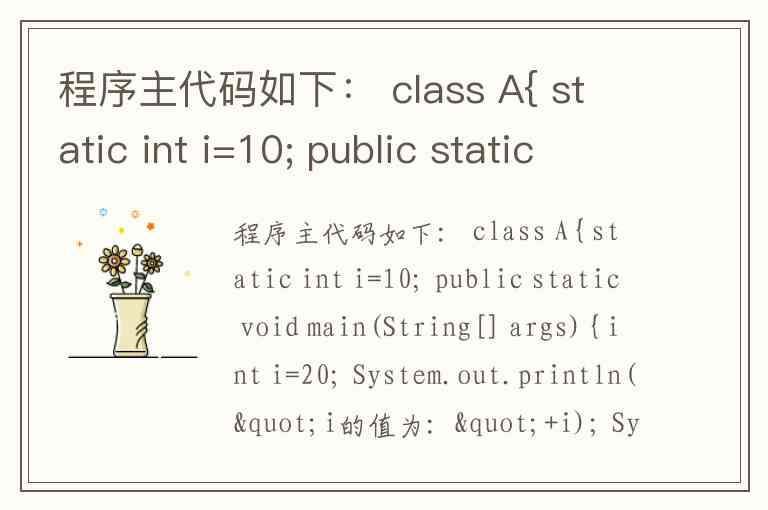
程序主代码如下: class A{ static int i=10; public static void main(String[] args){ int i=20; System.out.println("i的值为:"+i); System.out.println("i的值为:"+A.i); } } A. 10 20 B. 20 10 C. 10 10 D. 20 20
In Java, when a local variable has the same name as a static class variable, the local variable takes precedence within its scope. The code defines two i variables: a static class variable A.i = 10 and a local variable i = 20 in the main method.
The first print statement System.out.println("i的值为:"+i) uses the local variable i (since it’s in the same scope as the main method), outputting 20. The second statement System.out.println("i的值为:"+A.i) explicitly references the static class variable via A.i, outputting 10.
Answer: B
相关成语
- 下列四种物质中,汞元素(Hg)的化合价为0的是 A. Hg B. HgO C. HgS D. Hg(NO3)2
- 程序主代码如下: class A{ static int i=10; public static void main(String[] args){ int i=20; System.out.prin
- 专利权的客体包括( ) A. 技术秘密 B. 计算机软件 C. 发明 D. 实用新型 E. 外观设计
- 家庭联产承包责任制是当前我国农村社会主义集体经济主要实现形式。
- work过去式是( )
- 【就绪】是什么意思,【就绪】的释义
- 灰土属不属于其他垃圾 A. 属于 B. 不属于
- (单选题人民代表大会制度的关键是( . A. 国家的一切权力属于人民 B. 选民民主选举代表 C. 对人民负责、受人民监督 D. 以人民代表大会为基础建立全部国家机构
- 2010年南非世界杯足球赛的冠军是属于哪个国家的足球队?()。 A. 尼日利亚 B. 德国 C. 西班牙 D. 意大利
- 过渡时期的总路线的“两翼”是()。 A. 逐步实现国家的社会主义工业化 B. 实现对农业的社会主义改造 C. 实现对手工业的社会主义改造 D. 实现对资本主义工商业的社会主义改造
- 挨肩迭背
- 嗳声叹气
- 騃女痴男
- 騃童钝夫
- 碍足碍手
- 按兵束甲
- 暗锤打人
- 暗斗明争
- 暗度金针
- 安国富民
- 挨肩迭背
- 嗳声叹气
- 騃女痴男
- 騃童钝夫
- 碍足碍手
- 按兵束甲
- 暗锤打人
- 暗斗明争
- 暗度金针
- 安国富民
- 不主故常
- 北道主人
- 悲观主义
- 本本主义
- 本位主义
- 不由自主
- 仓卒主人
- 地主之仪
- 盗憎主人
- 打狗看主
- 挨肩迭背
- 嗳声叹气
- 騃女痴男
- 騃童钝夫
- 碍足碍手
- 按兵束甲
- 暗锤打人
- 暗斗明争
- 暗度金针
- 安国富民