4,10,8,17,12,( ),16,31 A. 14 B. 15 C. 23 D. 24
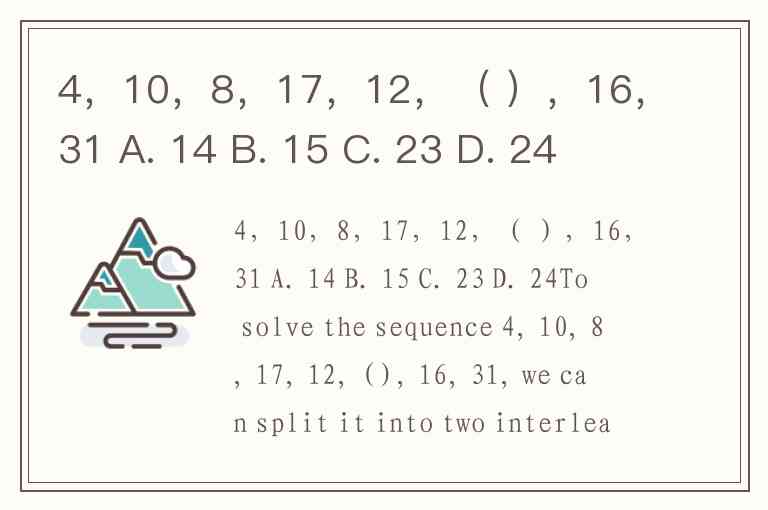
4,10,8,17,12,( ),16,31 A. 14 B. 15 C. 23 D. 24
To solve the sequence 4, 10, 8, 17, 12, ( ), 16, 31, we can split it into two interleaved subsequences by separating terms at odd and even positions.
Step 1: Analyze the odd-position subsequence
Terms at positions 1, 3, 5, 7: 4, 8, 12, 16.
The pattern here is straightforward: each term increases by 4 (4 + 4 = 8, 8 + 4 = 12, 12 + 4 = 16).
Step 2: Analyze the even-position subsequence
Terms at positions 2, 4, 6, 8: 10, 17, ?, 31.
We need to find the term at position 6 (the third term in this subsequence).
Calculate the differences between consecutive terms:
From 10 to 17: \(17 - 10 = 7\).
Assuming a consistent increment, the next term would be \(17 + 7 = 24\).
Verify with the final term: \(24 + 7 = 31\), which matches the 8th term in the original sequence.
Thus, the missing term (at position 6) is 24.
Answer: D.24
Does this pattern remind you of how interleaved sequences often hide simple linear trends? Next time you encounter a confusing sequence, try splitting it into odd/even subgroups—you might uncover two straightforward patterns instead of one complex one.
相关成语
- Chaddock征提示() A. 皮质脑干束损害 B. 脊髓丘脑束损害 C. 锥体束损害 D. 薄束损害 E. 大脑皮质
- 4,10,8,17,12,( ),16,31 A. 14 B. 15 C. 23 D. 24
- 用高级语言编写的程序称为() A. 源程序 B. 应用程序 C. 用户程序 D. 实用程序
- 下列关于平均动脉压(MAP)的叙述哪项是正确的( )。 A. 正常值8~10kPa B. MAP=舒张压+1/2(收缩压-舒张压) C. 正常值6~8kPa D. MAP=舒张压+1/4(收缩压-舒张
- 下列选项中的诗句填入《天平山中》一诗画横线处,恰当的一项是( )细雨茸茸湿楝花,南风树树熟枇杷。__,一路莺啼送到家。 A. 想见夜深人散后 B. 徐行不记山深浅 C. 林莺啼到无声处 D. 东风染尽
- 【掳】是什么意思,【掳】的字义
- 统一战线中的中间势力是指 ( ) A. 地方实力派 B. 民族资产阶级 C. 知识分子 D. 开明绅士 .
- 进入新时代,开启新征程。从2020年到2035年,我国将基本实现社会主义现代化。届时,我国将呈现的美好前景是①美丽中国目标基本实现②基本公共服务均等化基本实现③成为综合国力和国际影响力领先的国家④跻身
- 【裸尸】的近义词是什么,【裸尸】的同义词有哪些
- 党支部工作必须坚持党的宗旨和(),组织引领党员、群众听党话、跟党走,成为党员、群众的主心骨。 A. 思想路线 B. 组织路线 C. 群众路线 D. 人民路线
- 挨肩迭背
- 嗳声叹气
- 騃女痴男
- 騃童钝夫
- 碍足碍手
- 按兵束甲
- 暗锤打人
- 暗斗明争
- 暗度金针
- 安国富民
- 挨肩迭背
- 嗳声叹气
- 騃女痴男
- 騃童钝夫
- 碍足碍手
- 按兵束甲
- 暗锤打人
- 暗斗明争
- 暗度金针
- 安国富民
- 识大体,顾大局
- 你不仁,我不义
- 来无影,去无踪
- 局高天,蹐厚地
- 责己重,待人轻
- 知必言,言必尽
- 拥孺人,抱稚子
- 经一失,长一智
- 经风雨,见世面
- 官不威,牙爪威
- 挨肩迭背
- 嗳声叹气
- 騃女痴男
- 騃童钝夫
- 碍足碍手
- 按兵束甲
- 暗锤打人
- 暗斗明争
- 暗度金针
- 安国富民