37,40,45,53,66,87,( )。 A. 117 B. 121 C. 128 D. 133
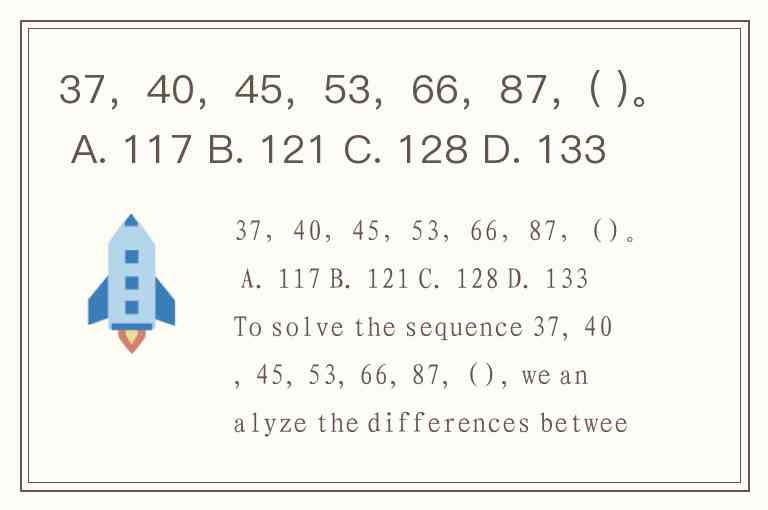
37,40,45,53,66,87,( )。 A. 117 B. 121 C. 128 D. 133
To solve the sequence 37, 40, 45, 53, 66, 87, ( ), we analyze the differences between consecutive terms and identify nested patterns:
Step 1: Calculate first-level differences
Compute the differences between adjacent terms in the original sequence:
\(40 - 37 = 3\)
\(45 - 40 = 5\)
\(53 - 45 = 8\)
\(66 - 53 = 13\)
\(87 - 66 = 21\)
First-level differences: \(3, 5, 8, 13, 21\)
Step 2: Identify the second-level pattern
Calculate the differences of the first-level differences (second-level differences):
\(5 - 3 = 2\)
\(8 - 5 = 3\)
\(13 - 8 = 5\)
\(21 - 13 = 8\)
Second-level differences: \(2, 3, 5, 8\). This is a Fibonacci-like sequence where each term equals the sum of the two preceding terms: \(2+3=5\), \(3+5=8\).
Step 3: Predict the next terms
Following the Fibonacci pattern, the next second-level difference is \(5+8=13\). Adding this to the last first-level difference (\(21\)) gives the next first-level difference: \(21+13=34\).
Step 4: Find the missing term
Add the new first-level difference to the last term in the original sequence: \(87 + 34 = 121\).
Answer: B. 121
相关成语
- 倾听
- 37,40,45,53,66,87,( )。 A. 117 B. 121 C. 128 D. 133
- 【简答题】消防安全四个能力是什么?
- 末次月经第一日是1997年10月27日,计算预产期是 A. 1998年7月30日 B. 1998年7月31日 C. 1998年8月1日 D. 1998年8月2日 E. 1998年8月3日
- 移动互联网是“互联网、移动、传统行业”三维发展。 A. 正确 B. 错误
- 社区卫生服务机构提供公共卫生服务和基本医疗服务,具有公益性质,不以盈利为目的
- 【一枕】的近义词是什么,【一枕】的同义词有哪些
- 政府对基础设施投资的原因是()。A.基础设施是资本密集型行业 B.基础设施建设需要大量的资本投入 C.建设周期长 D.投资形成生产能力和回收投资时间很长 E.基础设施工程量巨大
- 声音波形最低点与__间的距离称为振幅。
- “人民,只有人民,才是创造世界历史的动力。”该论断的提出者是()。A.马克思 B.恩格斯 C.列宁 D.毛泽东
- 挨肩迭背
- 嗳声叹气
- 騃女痴男
- 騃童钝夫
- 碍足碍手
- 按兵束甲
- 暗锤打人
- 暗斗明争
- 暗度金针
- 安国富民
- 挨肩迭背
- 嗳声叹气
- 騃女痴男
- 騃童钝夫
- 碍足碍手
- 按兵束甲
- 暗锤打人
- 暗斗明争
- 暗度金针
- 安国富民
- 挨肩迭背
- 嗳声叹气
- 騃女痴男
- 騃童钝夫
- 碍足碍手
- 按兵束甲
- 暗锤打人
- 暗斗明争
- 暗度金针
- 安国富民