34(). A. had had to B. had to C. has had to D. has to A. A 80-year old man from Cincinnati in A
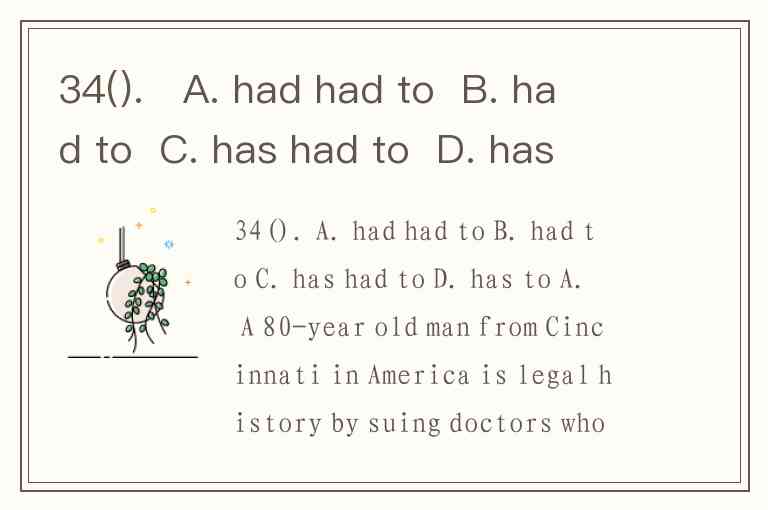
34(). A. had had to B. had to C. has had to D. has to A. A 80-year old man from Cincinnati in America is legal history by suing doctors who saved his wife. Edward Winter has witnessed his wife’ s death from a (21) attack. The doctors had tried to restart her heart with an electric (22) with remarkable success, but leaving her brain (23) . Her death was a long and (24) experience, which he did not want to go through himself. After she died he asked his doctor (25) to save him in (26) circumstances, but instead to let him die (27) . B. While out visiting in May 1988, Mr. Winter (28) the heart attack, which he was treated, and was rushed to St Franc’ is hospital in Cincinnati. The doctor who (29) him wrote down on his chart that he was not to be (30) but the duty nurse was not informed of Mr. Winter’s (31) . The nurse took the usual (32) action and tried to revive him with an electric shock. His life was saved (33) the treatment was not completely successful. Since then he (34) stay in a nursing home, partially (35) and barely able to speak without weeping. Though there is (36) hope of improvement in his condition, doctors say he could (37) many more years. The hospital (38) his story, arguing that the injury suffered by Mr. Winter is the (39) of an act of God and they (40) him over $ 60,000 for saving his life.
Let's go through this step-by-step:
34. The correct answer here is B. had to.
Explanation:
The sentence is referring to a past event, and since we’re talking about something that happened prior to the events already described (Winter staying in a nursing home), "had to" fits the past narrative and the fact that it is a past obligation.
Context:
"Since then he had to stay in a nursing home…" implies that it was a necessity or requirement that arose after the medical events described earlier.
Now, let’s go over the other missing parts with possible answers:
(21) attack: Likely heart attack, since he is mentioned to have had a heart attack.
(22) shock: Electric shock is commonly used in medical contexts when attempting to restart a heart.
(23) dead: The brain is typically described as being "dead" after such an event.
(24) traumatic: A long and traumatic experience fits the context, considering the circumstances described.
(25) not to try: He asked his doctor not to try to save him in certain circumstances. This makes sense with the overall meaning of his request.
(26) similar: This word fits the context. He didn't want to be saved under similar circumstances in the future.
(27) peacefully: He wanted to die peacefully, rather than being revived in an emergency.
For section B:
28. "While out visiting" implies he was out and about and experienced the heart attack. So, "suffered" or "had" could work, but "suffered" fits the tone here.
29. The doctor who treated him (the one who provided medical care).
30. He was not to be revived (or resuscitated).
31. The nurse was not informed of his wishes (his medical preference).
32. The nurse took the usual rescue action.
33. His life was saved, but the treatment was not completely successful, so we might say though the treatment was not entirely successful.
34. He had to stay in a nursing home (as discussed above).
35. partially paralyzed (it would be logical given the context of being unable to speak properly and being unable to move well).
36. There is little hope of improvement (the phrase "little hope" fits when there’s minimal optimism).
37. could live many more years (since he survived the heart attack, this fits logically).
38. The hospital denied his story (since they would likely dispute the cause of his condition).
39. the result of an act of God (This is a common legal phrase implying that the event was out of human control).
40. They offered him over $60,000 (likely a settlement or compensation).
Does that match your understanding of the text? Feel free to ask for clarification or to go over anything else!
相关成语
- 辞海 (打一成语)
- 坚持党 一切工作的领导,必须增强“四个意识”,即政治意识、大局意识、 核心意识、看齐意识。( ) A. 正确 B. 错误
- 34(). A. had had to B. had to C. has had to D. has to A. A 80-year old man from Cincinnati in A
- 以下哪一位是预防控制艾滋病的形象大使" ( ) A. 牛群 B. 成龙 C. 宁 D. 濮存昕
- 亭台上下共明月 (打一字)
- 【神虈】是什么意思,【神虈】的释义
- 坐车规则 (打二字数学名词)
- 该小组同学设计了甲、乙两套实验装置,对甲酸与甲醇进行了酯化反应的研究: 实验过程中选用的药品及试剂有:浓H2SO4、甲醇、甲酸还有()、()两种必备用品。
- 仅仅看中间 (打一成语)
- 八大浪费是指什么?
- 挨肩迭背
- 嗳声叹气
- 騃女痴男
- 騃童钝夫
- 碍足碍手
- 按兵束甲
- 暗锤打人
- 暗斗明争
- 暗度金针
- 安国富民
- 挨肩迭背
- 嗳声叹气
- 騃女痴男
- 騃童钝夫
- 碍足碍手
- 按兵束甲
- 暗锤打人
- 暗斗明争
- 暗度金针
- 安国富民
- 挨肩迭背
- 嗳声叹气
- 騃女痴男
- 騃童钝夫
- 碍足碍手
- 按兵束甲
- 暗锤打人
- 暗斗明争
- 暗度金针
- 安国富民